Litus Group
Client
AI TRANSFORMATION
Back-office and DATEV integration for Austria's largest entertainment operator.
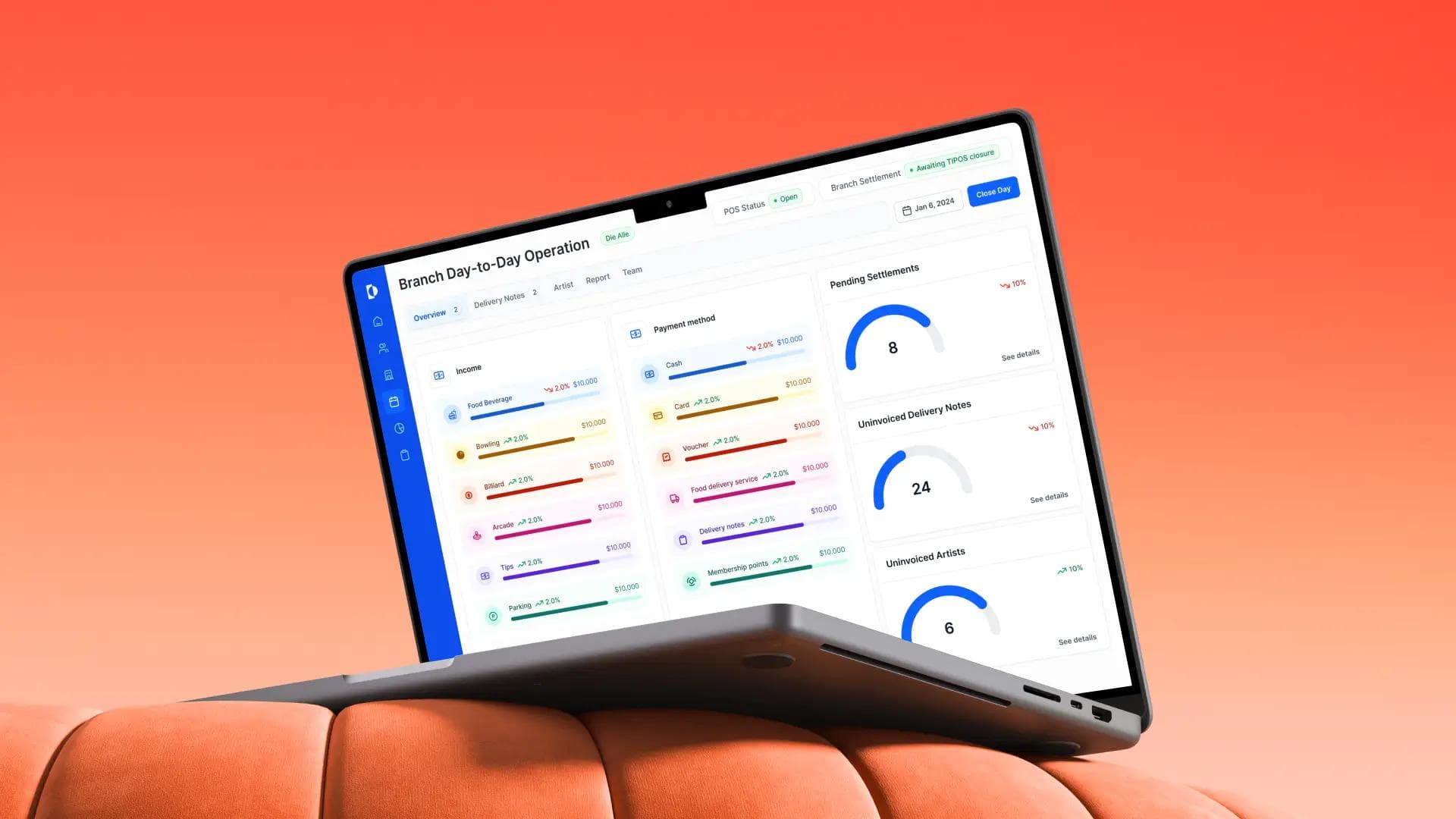
Litus Group
Client
Horeca
Industry
Business Processes Automation
Services
Austria
Region
2024-present
Year
Litus Group is Austria's largest entertainment operator, serving 1.4 million guests a year across bowling parks, family entertainment centres, destination gastronomy, and an ice cream operation. Every night, controllers close registers that ring up sessions, tokens, food, drinks, vouchers, and staff meals, paid with cash, card, and house credit across multiple terminals.
Before Camelot, the daily close was Excel plus paper, hand-keyed into DATEV by the Steuerberater the next morning. Closing one branch meant reconciling POS totals against card acquirer XML, tracking safe bags and Loomis pickups on a spreadsheet, and trusting that the person typing the numbers into DATEV did not miss a decimal.
Guests a year across venues
Daily close in Excel and paper
POS versus acquirer never agree
Hand-keyed into DATEV next morning
Camelot replaces the Excel-and-paper close with a 12-step wizard, tracks physical cash through four locations, and ships the DATEV export automatically. Classical enterprise integration: two upstream systems feeding conflicting data, one regulated tax system downstream, and a controller in the middle who needs everything to balance before the day can end.
The wizard walks the controller through every reconciliation surface for one branch, one day. Nothing advances until the step balances or the user logs a reason and an action for the delta. TIPOS, the Austrian POS, says the register rang up a figure in card payments; Payone, the card acquirer, says a different figure cleared. The gap is real and routine. Camelot makes the human explain every gap, and those reasons feed the posting descriptions that end up in DATEV.
01.
Pulls every register transaction per branch from TIPOS, every category, payment, staff comp, voucher, and delivery note, and normalises the raw data into the shape the close wizard needs.
02.
Ingests the daily settlement XML from Payone, groups by terminal, sums per product type, and filters by business partner ID so one branch's data never crosses into another's books.
03.
Tracks every euro across floor petty cash, main register, sealed safe bags, and the Loomis pickup, with photographic proof and mirrored Soll and Haben postings per handover.
04.
Every branch produces a sealed Buchungsstapel ready for the Steuerberater, chart-of-accounts aware, with one-click export and auto-created customer masters.
1.4M
Guests a year across the portfolio
12 steps
Guided close, nothing advances unbalanced
4
Cash locations traced floor to bank
7
Specialised DATEV mappers
The controller stops being the bottleneck and goes back to running the venue.
We built the back office that runs behind 1.4 million guests a year for Austria's largest entertainment operator, wired straight into their accounting. If your operation is straining against its own systems, we can fix that.
Starts with a free 30-minute discovery call.
A rebrand-matching website and a filterable product catalogue for an industrial supplier, built with High Contrast.